Why Energy Logistics Teams Are Automating Order Generation
This article explains why fixed delivery schedules and static K-Factor models leave meaningful efficiency on the table, how modern automated order generation works across multiple trigger types and forecasting algorithms, and why accurate upstream order management directly improves route performance, load factors, and stops per hour.
September 1, 2026
Elise Draper
Reading time:
7 Minutes
This article is published by Bestrane Edge, a delivery operations platform for complex logistics distribution. It examines why propane and fuel delivery operations are moving away from manual order generation and static K-Factor scheduling toward automated, data-driven order management. The article covers the three primary forecasting algorithms used in modern order automation -Linear Average, K-Factor, and Holt-Winters - and explains how accurate order generation improves downstream route performance and identifies the operational profiles where automated order generation delivers the clearest return. Bestrane Edge Orders is the modular order management solution referenced throughout.
Why Energy Logistics Teams Are Automating Order Generation
Most propane and fuel delivery operations have already made investments in routing. They have a system. Routes are planned. Dispatch is structured. And by any reasonable measure, the operation runs.
So why do so many operations managers still feel like they're leaving efficiency on the table?
The answer, consistently, comes back to orders.
Not the route - the orders that feed it.
The Hidden Inefficiency in Propane Operations
Order generation is still largely manual, and that’s where challenges begin.
Dispatchers rely on a combination of K-factor calculations, fixed delivery schedules, customer call-ins, and experience. These methods have worked for years, but they weren’t designed for today’s level of operational complexity.
The result is a consistent pattern of inefficiency. Orders are often created too early, leading to underfilled drops, or too late, resulting in urgent and inefficient runs. At the same time, valuable optimisation opportunities are missed, and dispatch teams are left constantly adjusting and reacting.
In practice, this leads to:
Trucks running below optimal capacity
Increased stop frequency and fragmented routes
Higher manual workload and rework
This isn’t just a process issue, it directly impacts delivery capacity, cost-to-serve, and overall operational performance.
What Is Automated Order Generation?
Automated order generation is the process of creating delivery orders using real-time data, forecasting models, and system-driven triggers, without relying on manual input.
Instead of waiting for a dispatcher to create an order, the system continuously evaluates tank levels, consumption patterns, forecasted demand, and delivery thresholds. When conditions are met, orders are automatically generated and passed into the routing engine.
The result is simple: every order entering the planning process is timely, accurate, and aligned to how deliveries should be executed.
Why Fixed Schedules and K-Factors Aren't Enough
Most propane and heating fuel operations still rely on one of two primary approaches to order generation: fixed delivery schedules, or K-Factor-based forecasting.
Fixed schedules are exactly what they sound like - deliveries triggered by calendar frequency rather than actual customer need. The problem is predictable. Fixed-cycle delivery often results in over-servicing customers, creating unnecessary delivery costs. Trucks make stops that don't need to be made. Fill rates are low. Cost to serve increase.
K-Factor forecasting is more sophisticated - it uses heating degree days and historical consumption patterns to predict when a customer's tank will reach the delivery threshold. K-factors have been a staple within the industry, and they work well under stable, predictable conditions.
The challenge is that conditions are rarely stable or predictable. The K-Factor calculation assumes each home consumes fuel at the same rate per Heating Degree Day but ignores outside factors that directly impact consumption. House size, insulation quality, occupancy patterns, appliance changes, weather variability, none of these are captured by a static K-Factor.
The result is delivery timing that looks right on paper but diverges from reality in the field. Customers who needed a delivery last week didn’t get one. Others who could have waited another ten days got a truck anyway.
This creates a disconnect. Routing systems are dynamic and highly optimised, while order generation remains static and reactive.
What Automated Order Generation Actually Does
Automated order generation isn't a single feature, it's a layer of intelligence that sits between your customer data and your route planning application, converting signals into orders without requiring manual intervention.
In practice, this means supporting multiple trigger types depending on the customer and the situation.
The forecasting algorithms that power automated orders are worth understanding. The three primary approaches each serve a different scenario:
Linear Average uses historical delivery and usage data to establish a consumption baseline. This is straightforward and reliable for customers with consistent patterns.
K-Factor, in its modern, software-driven form, doesn't just apply a static ratio. It recalculates the K-Factor from historical data, combines it with live weather forecast data, and updates delivery timing dynamically. This is materially different from the manual, static K-Factor, which most operations still use, and it's one reason the gap between traditional K-Factor forecasting and software-driven order automation is wider than many people assume.
Holt-Winters is a seasonal forecasting algorithm designed for products with strong seasonal patterns. BBQ propane, pool heaters, agricultural applications, industrial gases. It accounts for the predictable peaks and troughs that neither linear nor K-Factor approaches handle well.
Beyond forecasting, automated order generation handles enrichment. When an order arrives from an ERP system missing attributes that route planning requires, such as service windows, time constraints, and load specifications, the system adds them automatically using logic-based rules before the order reaches the planner. Orders that previously required manual cleaning before planning can now flow directly into the route optimizer.
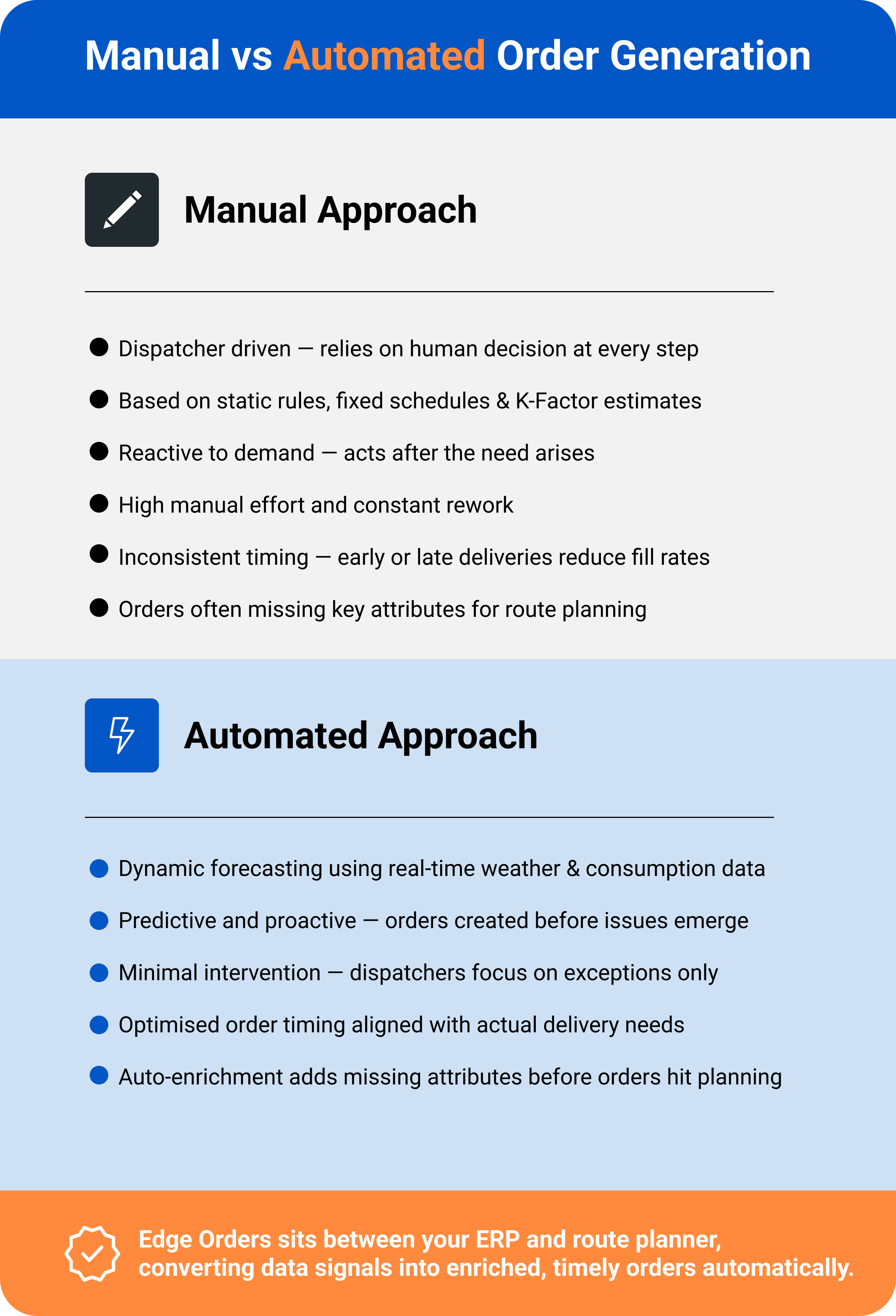
Manual vs Automated Order Generation
See infographic below which outlines the differences between manual and automatic order generation.
Manual vs Automated Order Generation Comparison Infographic
The Upstream Effect on Route Performance
One of the most compelling arguments for investing in order generation isn't about order management itself, it's about what happens downstream when the order pool is accurate.
Route planning software is excellent at solving sequencing and timing problems. It optimises the order in which stops are visited, accounts for time windows and vehicle capacity, and minimizes travel distance.
What it cannot do is fix a delivery that shouldn't have been created or compensate for one that was missing.
When the order pool entering planning is accurate, the route optimiser has better material to work with. Load factors improve because trucks are sent to customers who genuinely need a delivery at the time they need it.
Route quality improves because stops that were unnecessary have been removed. The number of low-fill deliveries, one of the most direct measures of wasted capacity, decreases.
The Integration Question
For many operations, the hesitation around order automation isn't conceptual, it's practical. The concern is disruption: changing the order management process means touching the ERP, touching the route planner, potentially touching customer-facing systems. The risk feels significant.
The shift in thinking that's enabling wider adoption is the move toward modular, complementary solutions rather than replacement systems.
Automated order generation doesn't require replacing your route planning software. It works alongside it, sitting between your existing ERP and CRM systems and your route planning platform, pulling in telemetry data, and converting it into enriched orders that flow directly into planning.
What Automation Doesn't Replace
Automation doesn’t remove the need for dispatchers.
Their role remains critical in managing exceptions, handling customer-specific requirements, and making operational decisions. What changes is how their time is spent.
Instead of manually creating and adjusting orders, dispatch teams can focus on higher-value activities that improve service, responsiveness, and overall efficiency.
Who This Matters Most To
The operations that tend to see the most meaningful impact from order automation share a few characteristics.
They typically have a high proportion of Auto-Fill or keep-full customers where the volume and variability of orders make manual management genuinely burdensome.
They operate across multiple districts or territories, where the aggregate complexity of order management across sites creates significant planning overhead.
They have already invested in tank monitoring infrastructure, meaning the telemetry data that powers accurate forecasting is already being collected, just not being used at the order generation layer.
Multi-state distributors, regional propane retailers with ten or more trucks, and fuel distributors managing high-volume commercial accounts with variable consumption patterns are the operations where the ROI case is most straightforward.
But the underlying logic applies across the sector: any operation where planners are spending meaningful time manually reviewing, adjusting, and cleaning the order pool before building routes is an operation where automated order generation has a direct case to make.
The Broader Shift in Propane Operations
The propane industry is moving quickly toward smart tanks, integration into other technology platforms and real-time data, with customers expecting visibility into levels, leaks, and usage, making monitoring solutions central to future propane logistics, safety, and automation.
The operations that move first to close the gap between the data they're collecting and the orders they're generating will carry a structural efficiency advantage into the years ahead. The route is already optimised. The next gain is in what feeds it.
Key Takeaways
Fixed schedule and static K-Factor order generation leave meaningful efficiency on the table - not because the route is wrong, but because the orders feeding it are imprecise.
Modern automated order generation combines multiple trigger types (Will Call, Schedule, Auto-Fill, Threshold) with dynamic forecasting algorithms (Linear Average, K-Factor, Holt-Winters) to produce accurate orders without manual intervention.
The order pool entering route planning directly affects route performance — load factors, fill rates, and stops per hour all improve when orders are more accurate upstream.
Modular solutions that work alongside existing route planning platforms (rather than replacing them) have lowered the implementation barrier significantly.
The tank monitoring infrastructure most operations have already invested in provides the telemetry data that automated order generation needs - the value of that data is unlocked at the order management layer.
Frequently Asked Questions
Does automated order generation replace dispatchers?
No. It reduces manual workload and allows dispatchers to focus on exceptions, customer needs, and operational decision-making.
Can automated order generation work with existing routing software?
Yes. It is designed to integrate between ERP/customer systems and routing platforms, improving the quality of data before it reaches planning.
Is this only relevant for large operations?
While the impact is more visible at scale, any operation relying on manual order creation can benefit from improved timing and accuracy.
Ready to close the gap in Order Generation?
Bestrane Edge Orders is a modular order generation solution designed to work alongside existing route planning platforms. It connects ERP, CRM, and telemetry data into a single configurable order engine, supporting Will Call, Schedule, Auto-Fill, and Threshold trigger types with Linear Average, K-Factor, and Holt-Winters forecasting algorithms. To see how it works alongside your existing platform, please contact us today.
get e-book
How Efficient Is Your Propane Operation?
This Bestrane Edge guide identifies the 5 operational gaps quietly costing propane delivery businesses time and money. Covering order generation, field data capture, real-time visibility, customer communications, and data utilisation. Includes diagnostic questions, a self-assessment scorecard, and a real-world case study from Eastern Propane & Oil, who achieved a 7% year-on-year improvement in gallons delivered per hour.







.webp)
.webp)

.webp)