The Data Foundation AI-Powered Logistics Actually Needs
AI-powered routing and dispatch are only as good as the data behind them. Here's why the "unglamorous" work of clean field data capture has to come first.
September 4, 2026
Elise Draper
Reading time:
5 Minutes
Short answer: AI-powered routing and dispatch tools are only as good as the operational data feeding them. Edge Capture is a mobile data capture and proof-of-delivery platform that turns field data, such as meter readings, delivery confirmations, and compliance records, into clean, structured, real-time data. It's not an AI tool itself; it's the foundation AI logistics tools need to actually work.
Every distributor is being told to "do something with AI" right now. Route optimisation, predictive delivery times, dynamic dispatch, the promises are everywhere. What's talked about far less is the unglamorous prerequisite underneath all of it: AI is only as good as the data you feed it.
A recent industry study surveying over 400 distribution leaders, sponsored in part by logistics technology providers including Descartes, found something worth sitting with. Logistics and delivery ranked dead last among five AI investment priorities, with the majority of distributors surveyed saying they hadn't even put it on their roadmap yet. The report's own conclusion wasn't "logistics AI doesn't work", it was the opposite: this is the opportunity hiding in plain sight, because almost everyone else is still on the sidelines.
But here's the part that gets skipped in most of the AI hype: distributors who jump straight to a routing algorithm or predictive dispatch tool without fixing their underlying data first are building on sand. The same research pointed to this directly - every AI use case depends on data quality, and that foundation has to come before the advanced applications, not after.
That's exactly the gap Edge Capture exists to close.
The data problem hiding underneath the AI problem
Ask most distribution operations what data their delivery vehicles actually generate, and the honest answer is: a lot, but most of it never makes it anywhere useful. A meter reading gets written on a paper docket. A delivery confirmation happens verbally over the radio. A proof-of-delivery signature sits on a piece of paper in the truck until someone gets around to filing it.
None of that is AI-ready. It's not structured, it's not timestamped consistently, it's not connected to the rest of your systems, and by the time it reaches anyone who could act on it, the moment it was useful has usually passed. You can't run a route optimization model on data that doesn't exist yet because it's still sitting in a driver's clipboard.
This is the quiet failure point behind a lot of stalled AI initiatives in distribution, not that the algorithms don't work, but that there was never a clean, real-time stream of operational data underneath them to begin with.
What Edge Capture actually does about it
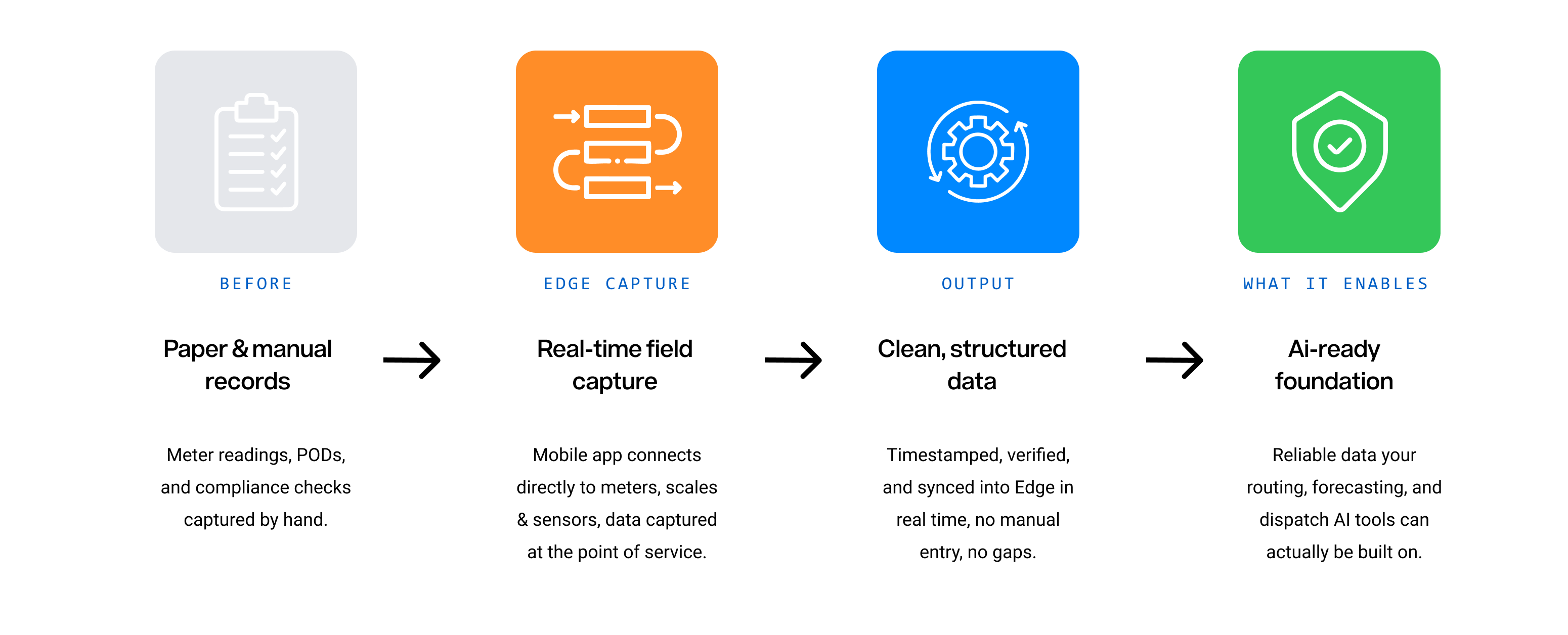
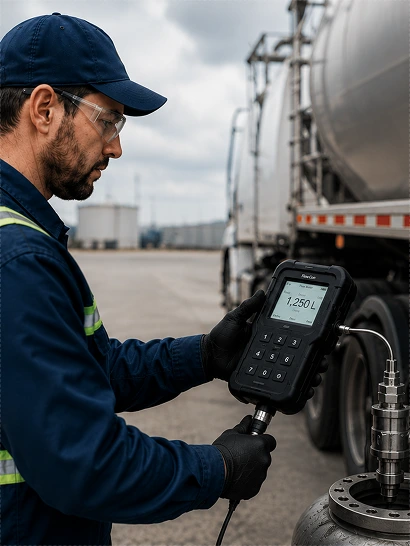
Edge Capture isn't an AI tool. It doesn't optimise routes or predict delivery windows. What it does is more foundational: it connects your driver mobile app directly to the field hardware you already use — meters, scales, sensors — and captures delivery actuals, compliance data, and verified proof of delivery in real time, the moment it happens.
In practice, this means:
Every delivery generates structured, timestamped data automatically — meter readings and scale actuals synced directly from the hardware, not transcribed by hand.
Proof of delivery is captured with GPS coordinates, signatures, and photos, creating a verified record the instant a delivery is completed.
Everything flows into the rest of your Edge platform in real time, rather than sitting on paper until someone manually enters it days later.
None of this is exciting on its own. It's the plumbing, not the product demo. But plumbing is exactly what has to work before anything built on top of it can.
How Edge Capture turns raw field data into an AI-ready foundation
Why this matters more, not less, as AI enters the picture
If you're a distributor thinking about where AI fits into your delivery operations such as dynamic routing, predictive service times, smarter dispatch - the sequencing matters. Building an AI layer on top of paper-based, inconsistent field data doesn't just underperform, it fails in ways that are hard to diagnose, because the model looks broken when the real problem is the data feeding it.
Distributors already capturing clean, structured, real-time delivery data are the ones positioned to actually benefit when they do add AI-driven routing or forecasting on top, because the foundation is already there. Everyone else is starting two steps behind, whether or not they realise it yet.
The practical starting point
You don't need to have an AI strategy figured out to get value from fixing this. Edge Capture pays for itself independently - fewer disputes, faster invoicing, cleaner audit trails, less time spent chasing paperwork. But if AI-powered logistics is anywhere on your roadmap for the next year or two, the sequencing question is worth asking now: is your operational data actually ready to feed something smarter, or is it still living on a clipboard?
Want to see what a real-time data foundation looks like in practice? Get in touch to talk through how Edge Capture fits into your existing fleet and systems.
Frequently asked questions
Does Edge Capture use AI?
No. Edge Capture is a data capture and proof-of-delivery platform, not an AI or routing tool. It connects driver mobile apps to field hardware (meters, scales, sensors) to produce clean, structured, real-time delivery data. That data is the foundation AI-powered routing and forecasting tools need to work accurately.
What data does Edge Capture collect?
Edge Capture collects delivery actuals from connected meters and scales, proof-of-delivery records (signatures, photos, GPS timestamps), and driver compliance data such as pre-trip checklists, all captured automatically at the point of service rather than recorded on paper.
Why does AI-powered logistics need clean data first?
AI routing and forecasting tools learn from historical operational data. If that data is inconsistent, delayed, or incomplete, as it typically is with paper-based processes, the resulting predictions and optimizations will be unreliable, regardless of how sophisticated the AI model is.
Is Edge Capture only useful if we're planning to adopt AI?
No. Edge Capture delivers value on its own, faster invoicing, fewer delivery disputes, cleaner audit trails, and less manual paperwork. Building AI-ready data is an additional benefit, not the only reason to use it.
What industries use Edge Capture?
Edge Capture is used in fuel distribution, industrial gas, and healthcare delivery environments. Industries where compliance documentation, chain-of-custody records, and accurate proof of delivery are business-critical.
get e-book
How Efficient Is Your Propane Operation?
This Bestrane Edge guide identifies the 5 operational gaps quietly costing propane delivery businesses time and money. Covering order generation, field data capture, real-time visibility, customer communications, and data utilisation. Includes diagnostic questions, a self-assessment scorecard, and a real-world case study from Eastern Propane & Oil, who achieved a 7% year-on-year improvement in gallons delivered per hour.




.webp)
.webp)

.webp)