Is Delivery Visibility Software Worth It for Fleets?

When does delivery visibility software pay off? How it differs from GPS tracking, what to count in the ROI, and when it's not worth buying.
October 21, 2026
Elise Draper
Reading time:
9 minutes
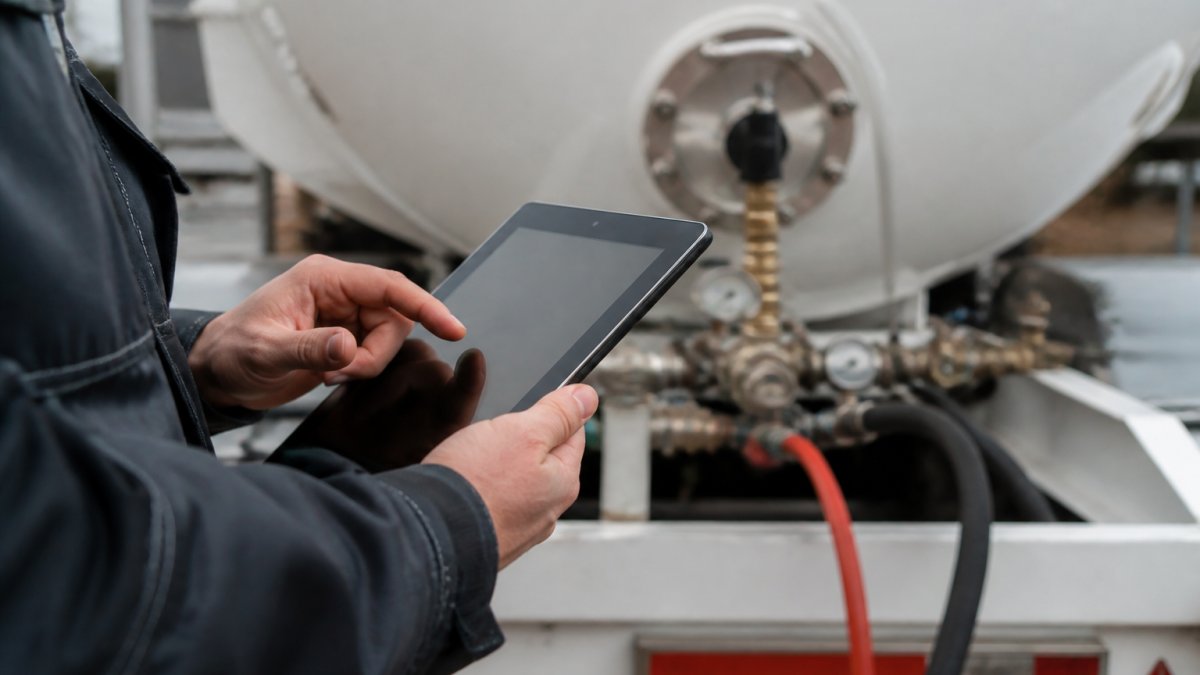
person using technology to enter field data from truck

Table of Contents

Is Delivery Visibility Software Worth It for Fleets?

Delivery visibility software connects vehicle tracking, routing and proof-of-delivery data into one live picture of every load in your network. For fleets running bulk liquids, fuel, LPG or industrial gases, the question is rarely whether visibility helps. It is whether the return justifies the licence, the integration and the change in how your team works.

The short answer: it pays off when you have enough delivery volume, enough exceptions and enough systems that already hold data nobody is joining up. That is a narrower group than most vendors admit. Ten trucks on fixed routes can run on paper and a phone.

A logistics operations manager in a control room reviewing live delivery routes on multiple wall-mounted screens, with colleagues in the background on headsets

How Delivery Visibility Software Compares to GPS Tracking and Full Fleet Management

Delivery visibility software sits between basic GPS tracking and a full fleet management suite. Knowing which one you need keeps you from overspending.

GPS tracking answers one question: where is the vehicle?

Full fleet management software covers maintenance scheduling, fuel cards, driver hours, compliance documentation and asset lifecycle. It is the system of record for the fleet itself.

Delivery visibility software focuses on the load and the customer. It joins vehicle location with delivery status, order data, proof of delivery and customer notifications.

Delivery visibility compared with GPS tracking and full fleet management
LayerCore questionTypical outputBest for
GPS trackingWhere is the vehicle?Map, location historySmall fleets, basic oversight
Delivery visibilityWhere is the load, and is it on time?Live status, ETAs, exception alertsOperations where a missed delivery is costly, such as bulk liquids, fuel, gas and healthcare
Full fleet managementHow is the fleet performing?Maintenance, compliance, utilisationLarge mixed fleets

Tracking a truck alone does not prevent a customer stock-out. If your customers depend on delivery timing, that gap is where visibility software starts to matter.

The Fleet Software ROI Calculation: What to Count Before You Sign

A fleet software ROI calculation only works if you count the costs and savings that actually move.  Build a simple payback model you can defend in a board paper.‍

Costs to include:

  • ‍‍Licence or subscription, scaled by fleet count
  • Integration work with your routing and ERP systems
  • Devices or telematics hardware, if not already fitted
  • Internal time for configuration, testing and training
  • Ongoing support or service arrangements

Savings and gains to include:

  • Fewer failed or repeat deliveries
  • Lower fuel and mileage, where better data feeds route planning
  • Less admin time from automated field data capture
  • Fewer customer service calls chasing delivery status
  • Better asset utilisation from knowing where vehicles and stock actually are

A Worked Payback Model You Can Adapt

You do not need a finance team for the first version. Express the annual benefit as a small number of avoided events, then compare that to the annual cost.

Payback model: fill in each line with your own figures
LineWhat to measureHow to express it
Failed or repeat deliveriesCount per month before deploymentAvoided events × cost per event × 12
Customer service callsCalls per delivery before deploymentCalls avoided × minutes per call × loaded hourly rate
Empty runningMiles or hours per weekMiles or hours saved × fuel and labour rate × 52
Admin timeHours per week on field data entryHours saved × loaded hourly rate × 52
Asset utilisationVehicles or tanks idle per weekExtra productive hours × contribution margin

Add the five lines to get your annual benefit. Then divide your first-year cost by that benefit and multiply by 12 to get payback in months. If payback is longer than your normal capital threshold, the software may not be worth it yet.

Where the Model Gets Harder

Some benefits are real but hard to quantify upfront. Customer retention is the clearest: a prevented stock-out may save an account, but you cannot know which one in advance.

For fleets running vendor-managed resupply, the model must also account for order generation and capture. When you decide when a customer needs product, a missed top-up is not just a late delivery but a service failure that can trigger a credit, an emergency run or a lost contract.

Delivery Visibility Software Integration With Routing and ERP Systems

Delivery visibility software integration is where most projects succeed or stall. The software itself is rarely the hard part. Joining it to a heavily customised ERP is.

A visibility layer should sit alongside your existing routing and ERP systems rather than replace them.

What to check before committing

  • Does the platform read from your ERP without requiring a rebuild of it?
  • Can it write delivery confirmations and field data back automatically?
  • How does it behave when a vehicle is offline for part of the day?
  • What happens to data quality when drivers enter information manually?

The offline question is critical for field projects. If drivers work in patchy coverage, a system demanding constant connectivity may face challenges where it's needed most.

Bestrane Edge is a modular platform built to sit alongside your existing routing and ERP systems. Edge Capture, for example, connects the driver mobile app to meters, scales and sensors to capture delivery actuals and proof of delivery.

Why Bulk Liquid Delivery Management Software Changes the Math

Bulk liquid delivery management software changes the return calculation because a failed delivery costs more in this sector.

When a fuel, LPG or industrial gas delivery goes wrong, the customer gets a tank running toward empty, a production line that may stop, or a compliance problem.

That shifts the value of visibility in three ways:

  • Order generation. Resupply decisions based on actual consumption and tank data, rather than a fixed schedule or a phone call.
  • Exception management. You know which tanks are at risk before the customer calls, so you can fix the problem ahead of the failure.
  • Proof of delivery and compliance. Captured field data that stands up to scrutiny for hazardous and regulated products.

For healthcare supply chains, the same logic applies with different stakes. Delivery visibility supports proof-of-delivery compliance and gives customer service teams the information to answer questions before they become complaints.

This is the sector Bestrane Edge was built for.

When Delivery Visibility Software Is Not Worth the Investment

Delivery visibility software is not worth it when your operation is simple, stable and low-consequence.

In those cases, basic tracking and a good dispatcher may be sufficient, as you might be paying for exception handling you rarely need.

A second scenario: if your team is not ready to change how it works, the software will not fix anything. Visibility tools surface problems, they do not resolve them. If nobody owns the exception alerts, they can become noise.

Matching the Software to Your Fleet Size and Use Case

The right choice depends far more on delivery complexity than vehicle count. Two fleets with the same number of vehicles can need very different tools if one delivers bulk liquids on vendor-managed resupply and the other runs fixed parcel routes. Use the guidance below as a starting point, then test it against your own exception rate.

By Fleet Size

  • ‍Under 30 vehicles, simple routes: basic GPS tracking is usually enough. Revisit when you add customers, product lines or regulatory requirements.‍
  • 30 to 100 vehicles, mixed routes: this is where delivery visibility starts to pay. You likely have enough exceptions to justify the platform, and enough complexity that spreadsheets stop working.‍
  • 100+ vehicles, multi-site or regulated products: a visibility layer becomes close to essential. At this scale, small improvements in route planning and asset utilisation compound quickly, and customer service cannot function without live delivery status.

By Fleet Type

  • ‍Private fleets delivering your own product have the clearest case: you control the order, vehicle and customer relationship, so visibility improvements flow straight to service and cost.‍
  • Mixed fleets using owned vehicles and contracted carriers need visibility that spans both. The value is consistency: one view of delivery status regardless of who is driving.‍
  • Multi-carrier operations face the hardest integration problem. The payoff is exception detection across carriers, but only if data quality is high enough to trust. If carriers cannot provide reliable status data, the visibility layer surfaces noise rather than insight.

By Use Case

  • ‍Bulk liquids, fuel, LPG, propane, specialty gases and other bulk liquids: prioritise platforms that handle order generation, field data capture and proof-of-delivery compliance, not just tracking. This is the profile Bestrane Edge is designed for.
  • Healthcare and regulated supply chains: proof-of-delivery compliance and audit-ready field data matter more than route optimisation. Look for capture that stands up to scrutiny.‍
  • General distribution: route planning and customer ETAs usually drive the return. Basic visibility can often be sufficient until exception volume grows.

The Scale at Which Visibility Pays Off

Across all sizes and types, the deciding factors are the same: how many exceptions you handle, how much customers depend on accurate ETAs, and how many systems hold data nobody is joining together. Visibility starts to pay when the cost of a single failed delivery is high enough that preventing a handful each month covers the platform. Below that threshold, a good dispatcher and basic tracking may be more suitable than a full visibility platform.

Conclusion: Making the Call on Delivery Visibility Software

The decision comes down to one question: are your delivery failures expensive enough to prevent? If so, delivery visibility software earns its place.

For fuel, LPG, industrial gas, bulk liquid and healthcare distribution, the answer is usually yes, because a failed delivery carries operational and compliance consequences that a tracking dot cannot address. Bestrane Edge was built for exactly this, with a modular platform that works alongside your existing routing and ERP systems, automated order generation and field data capture, and a Premium Service Bundle for ongoing logistics specialist access.

If you still run on paper dockets, start with the Paper Docket Audit. It is 12 quick questions that show how much manual data capture is costing you

Frequently Asked Questions

Is delivery visibility software worth it for a private fleet?

It depends on how much hidden cost sits in your current operation. If dispatchers manually reconcile proof of delivery, drivers run overlapping routes or customers call for status updates, the software can provide real value. For fleets under roughly 30 vehicles with stable, simple routes, the case is weaker, and a spreadsheet plus basic tracking may be enough.

How does delivery visibility software differ from fleet tracking software?

Fleet tracking shows where vehicles are. Delivery visibility software connects that location data to orders, routes, proof of delivery and customer notifications. Tracking answers "where is the truck?" Visibility answers "which order is on that truck, will it arrive on time, and does the customer know?" That order-level link is what makes delivery performance measurable.

Can delivery visibility software integrate with routing and ERP systems?

Yes, when the platform is built as a data layer rather than a replacement. The practical test is whether it can read orders from your existing ERP and write delivery status, timestamps and proof of delivery back without custom middleware. Ask any provider to demonstrate this against your actual system, including heavily customised or older ERP versions, before you commit.

How can a fleet measure the value of delivery visibility software?

Build a before-and-after scorecard from metrics you already collect: on-time delivery rate, cost per delivery, failed or redelivered drops, dispatch hours per day and customer service call volume about delivery status. Capture at least four to six weeks of baseline data before go-live, or a full quarter if your volumes are seasonal. Then compare the same metrics at 90 days. That comparison, not a vendor's case study, is the number that justifies renewal.

‍

— Related

Related Blogs

— Used worldwide

Trusted by leading logistics operations worldwide.

Easter company logo
Fern company transparent logo
New Era transparent logo
origin transaprent logo
Blue and white logo with letter R and the word Recochem below.
Eastern Propane company logo with blue text and a propane tank graphic.
Fern Energy company logo with a green geometric shape and the word fern in dark letters.
New Era Energy logo with stylized NE letters in green and yellow and bold black text.
Blue and white logo with letter R and the word Recochem below.
Eastern Propane company logo with blue text and a propane tank graphic.
"We gained a 7% year-on-year improvement in gallons delivered per hour."
Eastern Propane & Oil
— Used worldwide
See how operators run smarter with Edge.
— Get started

Ready to run a smarter delivery operation ?

See how Edge can extend what you already have and build the operational capability you've been missing.