Visibility is still the biggest gap
Shippers name real-time visibility as their top operational gap (27%), while LSPs point to automation (26%) and carrier connectivity (25%). GPS and ELD tracking is common, used by 52% of shippers and 59% of LSPs. Even so, 35% of shippers and 41% of LSPs still depend on spreadsheets or post-delivery emails.
AI is stuck at the data layer
Most organisations are exploring, piloting or partially deploying AI. Data quality is the leading barrier, followed by integration complexity (39% of shippers, 38% of LSPs) and unclear ROI (31% and 35%). Skills and change management rank lower, which suggests teams are ready but the digital infrastructure behind AI is not. Where AI is live, LSPs use it for real-time visibility (67%) and route or load optimisation (63%). Shippers lead with data entry and customer service (both 58%).
Automation has further to go
Only 16% of shippers and 13% of LSPs describe their operations as fully automated with AI. Among those using AI, shippers report the biggest gains in lower administrative and labour costs (55%), while LSPs cite better service (53%).
What this means for fuel, propane and bulk-liquid delivery
The survey covers freight transportation rather than bulk fuel delivery, but the pattern carries over. Route planning decides where trucks go, and results before and after the route depend on the quality of the data. Edge is built to work alongside your routing platform, including Descartes, and adds the layers around it:
- Before the route: Edge Orders generates and enriches orders from consumption, telemetry and ERP data, so planners start with accurate orders instead of manual entry.
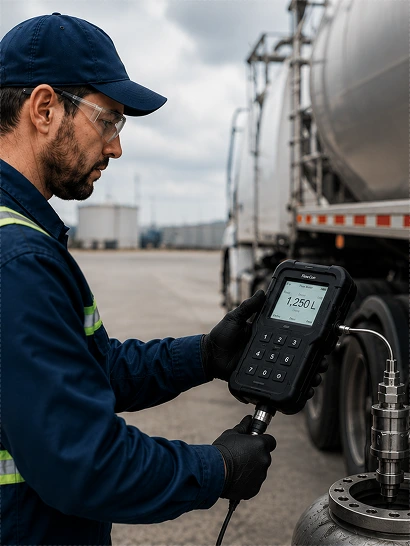
- At the delivery: Edge Capture reads volume, temperature and totaliser from meters scales or sensors, giving clean, auditable data at source rather than re-keyed paper.
- After the delivery: Edge Insights compares planned against actual in real time, so dispatch can act before customers call.
Source: Descartes, 2026 Global Transportation Management Benchmark Survey.
FAQ
What is the Descartes Global Transportation Management Benchmark Survey?
It is Descartes’ annual research report, now in its 10th year. The 2026 edition draws on 300 senior decision-makers at North American shippers and logistics service providers, covering growth outlook, visibility, automation, AI adoption and priorities.
How many organisations use AI at scale in transportation?
Fewer than one in five: 19% of shippers and 15% of LSPs. Most are still exploring (29% of shippers, 38% of LSPs), piloting or partially deploying it.
What is the biggest barrier to scaling AI?
Data quality, cited by 33% of shippers and 45% of LSPs. Integration complexity (39% and 38%) and unclear ROI (31% and 35%) follow.
Does the survey cover propane or fuel delivery?
Not specifically. Respondents came from manufacturing and distribution (32%), freight brokerage (28%), 3PL/4PL (22%) and retail (18%). The section on fuel, propane and bulk-liquid delivery is Bestrane’s interpretation, not a survey finding.
How does Bestrane Edge relate to route planning?
Edge does not replace your routing system. It adds the layer around it: order generation before the route, field data capture at delivery, and customer visibility and reporting afterwards.